


Page is under construction.
Check the github issues for ways to contribute! Or provide your feedback in this quick form
Check the github issues for ways to contribute! Or provide your feedback in this quick form
Livepeer Story
Doug Petkanics - Building Livepeer
What if video — the most captivating, expressive medium online — ran on open, permissionless infrastructure instead of expensive, proprietary systems?
This conviction, alongside a deep belief in both the practical need and open source potential of decentalised open infrastruture, led them to found Livepeer.
Doug and Eric set out to revolutionise video streaming infrastructure from the hardware infrastructure up by:
- Turning idle GPUs around the world into a competitive marketplace,
- Using crypto-economic incentives to guarantee reliability and quality,
- Delivering real cost reductions via decentralised economies of scale.
Livepeer Vision
Livepeer exists to power open, decentralized video infrastructure — infrastructure that anyone can build on, operate, and benefit from. From the beginning, Livepeer’s goal has been simple but ambitious: Make video infrastructure open, permissionless, and economically efficient — the way the internet itself was meant to be. As video becomes increasingly real-time, interactive, and AI-driven, Livepeer is evolving to meet the next wave of demand: real-time AI video pipelines.(MOVE ME) Livepeer Evolution
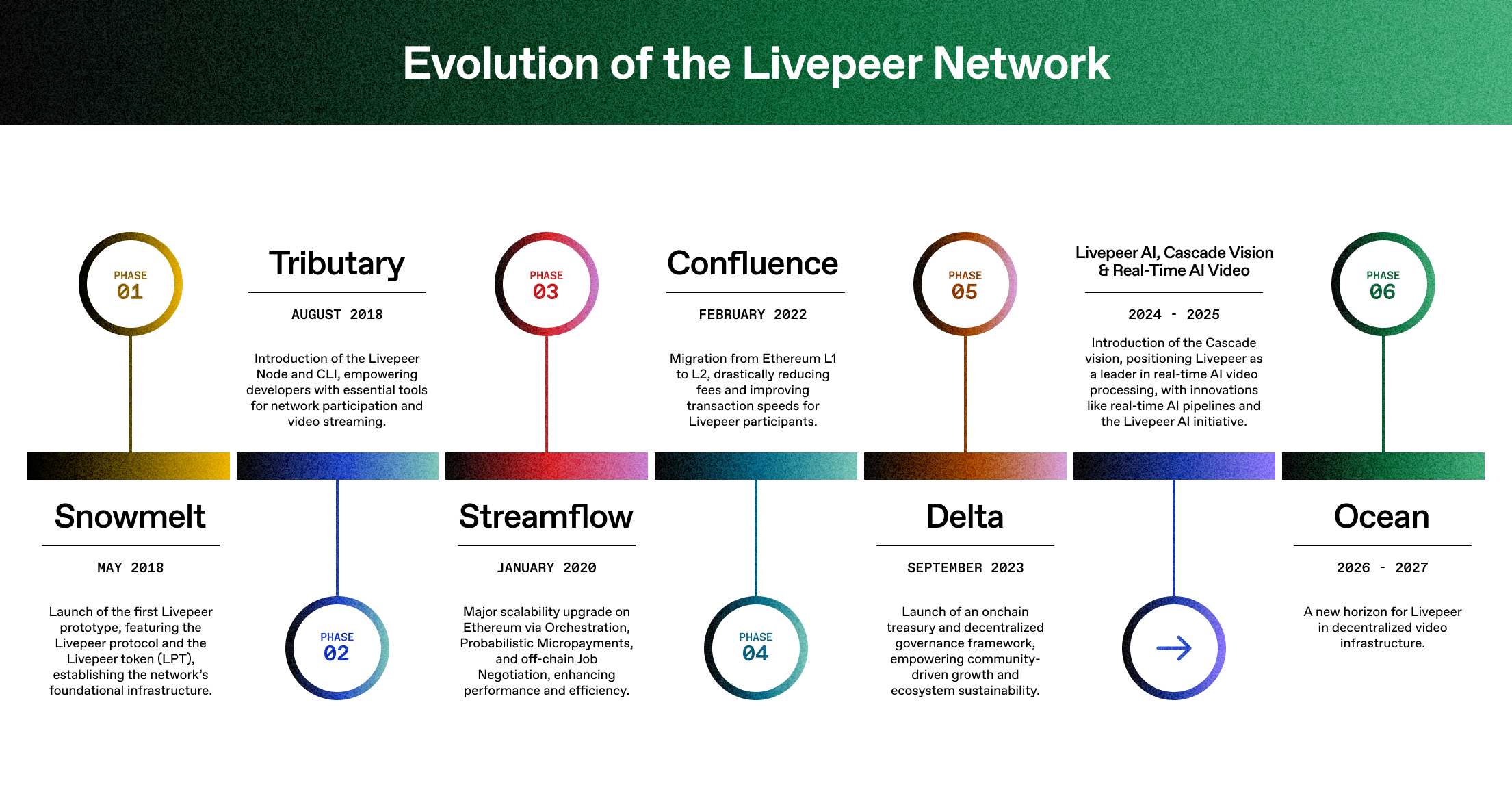
Evolution of the Livepeer Network
- Proposed in LIP-1 and went live in April 2018.
- Marked the launch of Livepeer Alpha on Ethereum mainnet.
- The first functional version of the network-enabled basic video broadcasting and the generation of LPT rewards from an initial total token supply of 10 million LPT at Genesis.
- Propsed in LIP-10 and went live in August 2018.
- Enabled developers to build on Livepeer’s video infrastructure and addressed major pain points identified in the protocol’s first iteration.
- Proposed in May 2019 in LIP-30 and went live in January 2020.
- Expanded the network’s node capacity from 25 to 100, introduced the “Transcoder” role, splitting the original orchestrator role to drive network efficiency and performance.
- This upgrade also introduced Probabilistic Micropayments and offchain job negotiations.
- Initially proposed in September 2021 in LIP-80 and went live in February 2022.
- This upgrade deployed Livepeer on Arbitrum, moving the protocol’s functionalities to the Layer-2 network.
- This significantly reduced the protocol’s gas fees and offered faster transactions to network participants.
- Proposed in April 2023, Livepeer Delta went live in October 2023 following the passing of LIP-91.
- This upgrade deployed a community-governed onchain treasury for the protocol Livepeer.
- It also introduced new parameters to Livepeer’s staking contract that routes a portion of LPT’s inflationary emissions to the treasury, which is used to fund Public goods.